The first ever GodBlog 2005 Conference is coming up in just a few weeks. It's a conference for Christian bloggers to meet, network and learn more about the possibilities and potential of blogging. An recent article by Ted Bolsinger provides some interesting thoughts on the upcoming conference.
I plan on being there myself... hope to see you there.
Tuesday, September 20, 2005
87th Christian Carnival
The Carnival's up again, and I have a post there. Check it out to find some recent posts of some interesting Christian bloggers.
Tuesday, September 13, 2005
Review of Chaos and Creation in the Backyard, by Paul McCartney. A Grownup Work from a Genius of Pop

Before I begin my review, I would like to retire a false legend about the Beatles, one that has circulated for a long while. Please bear with me as I address this issue briefly; it will be relevant to the album review.
The myth is this: that John Lennon was the true artist of the Beatles; their leader, and the driving force behind their magic. This legend of course misses the obvious fact that the music of the Beatles was produced by the alchemy of four unique talents, each of whom made an important and significant contribution to the mix. It was the combination of their voices, inspired songwriting, their cohesiveness as a band, and their winning personalities that made the Beatles so special-- even the Beatles themselves often claimed that they felt like four parts of the same person. So their success is not owing to any one of them alone.
Lennon certainly was a natural leader within the group and had an originality that was critical to the Beatle's sound. But his songwriting partner, McCartney, was no less an original, and it's almost certain that Paul took the lead in Beatle creative sessions on songs for which he was the primary originator (and this was probably more than half of their recordings).
Especially in their earlier work, Paul and John's songwriting was a true collaboration. But as time went on, they wrote more as individuals, and would bring in their ideas for the rest of the group to work on. One began to see the contrast in their musical personalities.
It's when we examine their output as solo artists we more readily see the differences (and similarities) in the style and temperament of Lennon vs. McCartney. Paul was clearly the sunnier personality, reflected both in his lyrics and in his more upbeat tunes. The darker Lennon exposed the pain and even neurosis of his psyche, usually with good results musically. One way that they were similar, however, is that both were Romantics [definition of Romanticism: An artistic and intellectual movement originating in Europe in the late 18th century and characterized by a heightened interest in nature, emphasis on the individual's expression of emotion and imagination, departure from the attitudes and forms of classicism, and rebellion against established social rules and conventions].
Perhaps one of the best examples of this Romanticism is that each of them wrote tender, sensitive odes to love/lover (Paul: My Love, Warm and Beautiful and countless others, John: Oh My Love, Woman, and lots more).
Paul was more of a craftsman in his approach to writing and producing, polishing final productions to a sheen; whereas it seems John generally preferred a more raw sound, one he viewed as more spontaneous and authentic. Of the two, Paul was almost certainly the more versatile musician, with a wider scope of styles in his writing and playing. But again, these generalizations are limited, for Paul could be rough and raw-sounding, and John's music shows he was quite able to create smooth, polished pop songs when he chose to.
Paul was much more prolific in his post-Beatles output, even before Lennon died in 1980. It's hard to imagine him taking off five years from releasing any music, as Lennon did in the mid-70's. His ability to generate so many ideas is a mark of Paul's genius-- yet it has at times resulted in his putting out material that is just not up to his own high standards, nor up to the high quality of the Beatles catalog. Whether writing together or separately, these two great writers sparked one another's creativity and raised each other's game, if not through collaboration, then often by competition. So we must retire all the nonsense about Paul being a no-talent, and John the true genius.
With his overflow of musical ideas, McCartney has quite often recorded what sound like "snippets" or even drafts of songs. Sometimes he molds these into great songs, but often he has just released such material "as is", with not great results. I think this is one reason why critics have not always been kind to Paul's solo work. But another, as mentioned above, is the myth that Paul was not as inspired or as edgy a talent as John. Thus Paul's solo career has been underrated by many critics, but I believe that in due time his work will garner the respect and appreciation it deserves as outstanding pop music.
Nevertheless, especially from a lyrical standpoint, it does seems that Paul has always had need of a strong editor; one that he could respect and who would unflinchingly provide honest appraisal of his ideas along with constructive advice. One imagines that John was that kind of writing partner for Paul. But writing without a partner, Paul has sometimes given in to his worst tendency-- sentimentality-- and produced mawkish lyrics or cornball songs. Every artist has idiosyncrasies that contribute to their strength as an artist, but the same strength at extremes turn into weakness. Lennon, for example, had a gift for being bluntly truthful in his lyrics, in a way that seemed to connect with many. Yet songs like "Mother", or more so, "I Found Out", are probably too revealing of the dark side to be "listener-friendly".
Likewise McCartney's gift of generating lots of musical ideas, his seeming perfectionism in the studio, his wonderful gift of melody and his optimistic nature often have combined to produce works of pure pop genius. Yet those same strengths can be liabilities. He has had a tendency either towards overproduction, or the seeming opposite tendency to release half-finished tunes. His tendency to put on his "brave face" has perhaps caused him to be a little too glib and superficial in his lyrics.
But on Chaos and Creation, working with a fresh producer, Nigel Godrich (Radiohead, Beck) Paul reins in some of these negative tendencies. The lyrics are more mature and reflective. The spare, tasteful musical arrangements complement the thoughtful quality of the words perfectly. The complex essence of Paul's musical personality emerges: optimism (Fine Line) is juxtaposed with melancholy (Jenny Wren, At the Mercy); nostalgia (English Tea) contrasted with anticipation (Promise To You Girl). Apparently Godwin persuaded Paul to leave out his band and record almost all the parts himself (something Paul has done before but not since McCartney I and II). The result is an album that feels "organic": all the parts relating to one another well. And best of all, McCartney's voice sounds incredible (it's hard to believe he's 63!)-- it's strong and confident on the uptempo tracks, and vulnerable, wise, and, for lack of a better word, beautiful, on the more mellow numbers.
Chaos and Creation in the Backyard opens strongly, with Fine Line (also the first single), an up-tempo number that may not grab you on the first listen but hooks you if you listen more than once. It has a good lyric, of more depth than usual for a McCartney pop single. This is followed by "How Kind of You", a moody, mellow piece that reflects on the kindness of a friend (lover?) who was there in a time of need. Like many of the songs on this album, it grows on you with repeated listening.
The beautiful, haunting Jenny Wren is next and features lovely acoustic guitar by Paul, in the tradition of some of his great guitar work on songs such as Blackbird, or Calico Skies. Its minor key and lovely chorus are well-matched to the simple, evocative lyrics. The plaintive solo (by Pedro Eustache, on an instrument called the duduc) is one of the high points of the album. I think this song may join the McCartney canon of greats.
At the Mercy, to my ears, has classical music elements; there are many interesting twists and turns to follow in this complex tune. The complexity of the tune perhaps makes it less easy to remember, but this is one of the best songs on the album.
McCartney has said that on the next number, Friends to Go, he felt inspired by George Harrison-- and the song does have a "“Travelling Wilburys"” kind of feel. In fact, it is the kind of tune George might have written, in his later career. It's a very likable tune and good tribute to George, if that is what it is meant to be.
English Tea changes the mood again with its opening, which sounds like a passage imported from one of Paul's classical pieces. The song itself seems to be a mild parody of aristocratic life. It reminds me a bit of "Piggies" from the White Album, except where Piggies was an attack on the aristocracy, English Tea shows affection for the old English ways.
Too Much Rain opens with chords that sound familiar (they remind me of the song Lonely People by America). But it turns into another beautiful melody from Paul, and the song has a lovely piano/guitar arrangement. The lyrics may sound trite at times, but the song works anyway. A great pop piece.
On A Certain Softness, McCartney creates a Latin-flavored piece which really works well, due to another well-conceived and executed arrangement. The song adds yet another bit of variety in texture to the overall album. The melody is excellent, if not quite as instantly memorable as some of McCartney's best work along these lines (And I Love Her, for example). Being a fan a Latin-flavored music, this is one of my favorites on the album. Paul'’s harmonies on the middle section are gorgeous.
Riding to Vanity Fair marks perhaps a first for McCartney, in that he reveals bitter feelings, the result of betrayal in friendship. The song's slow, atmospheric quality heightens the feeling of dazed confusion expressed by the words. The orchestration is excellent, recalling the song "Distractions", but is more understated here. I think McCartney should keep writing in this vein, because the lyrics in this song feel more real and more honest than the perfect ideal described in the very next song, Follow Me. One wonders, to what human being could these words be expressed ("I can rely on you to guide me through any situation"? Interestingly, since I write from a Christian point of view, this song, which seems to be about God, should probably appeal to me. But its melody isn't quite as inspired as other songs on this album, and one isn't so sure if there is heartfelt conviction in the song. For these reasons, Follow Me was probably my least favorite track.
Promise to You Girl is another great pop song from McCartney, inserting a needed burst of energy into this mostly mellow album. Paul, "looking through the “backyard of my life"”, realizes it's "“time to sweep the fallen leaves away"”. The song expresses the idea of taking stock and looking to the future with a determination to leave behind a positive mark on this world. And it does so with a catchy, fun tune that is typical Paul. This would be a good choice for the next single.
On This Never Happened Before Paul has crafted yet another gorgeous love song, with chord changes reminiscent of Burt Bacharach. In an interview, Paul relates how he lent out the song, prior to its official release, to a couple getting married (very sweet).
The album closes with a pair of love songs. Like Too Much Rain, Anyway also opens with a familiar-sounding chord progression (remember "People Get Ready" by Curtis Mayfield?). Still, Paul's song veers into much different musical territory after that. The song is a plea for lovers to re-unite (it feels perhaps as if they have been parted by a quarrel). But the narrator believes that their love is "strong enough to take it on the chin" and to "cure each others sorrow". He waits for her to "make that call", "anyway" she can. Both This Never Happened Before and Anyway could be criticized for their simplistic lyrics, but the music expresses emotional nuances that fills in what the words do not. Perhaps if the words were more complex, they might clash with the musical expression of emotion.
Finally, there is a instrumental jam that follows the last song, Anyway, that has points of interest, although it is not very cohesive. It sounds like three different musical passages strung together, but the best of these passages is the piano section.
If you're planning on purchasing the album, I'd strongly recommend buying the Special Edition version, which includes along with the CD an entertaining and informative 50 minute DVD, in which Paul talks about the making of Chaos and Creation.
Chaos and Creation is a grownup work from an artist who obviously still has lots of creative juices flowing. Some fans and critics may lament the lack of "rockers" on this album, but it seems Paul's latest batch of inspiration just didn't include those types of songs. Working with a strong producer was definitely a good move for Paul: this is a thoughtful, well-crafted album with no "clunkers", as have appeared on previous albums. Paul no longer needs to stake his reputation on the body of work he created with the Beatles, as wonderful as that body of work was. His body of work as a solo artist, and with Wings, is equally impressive. It remains to be seen whether or not this album contains songs that will live up to very high standards set by all of Paul's past work, to become his new classics. Still, McCartney is a true genius of pop, and he can (and should) hold his head up high with this album.
Friday, September 09, 2005
Was Katrina Intelligent Design?
John Piper has written what I think is the best word I've yet read about the implications of Katrina. Clink on the title link above to read his excellent article.
Thursday, September 08, 2005
Christian Carnival 86
My post Mysterious Ways appears in the latest Christian Carnival, hosted by Technogyspy.
Some very interesting ruminations on Katrina appeared in this past week's Carnival, which prompted me to think about the issue and write my own take on it.
As always, the Carnival is an excellent way to read thought-provoking Christian blogging and discover new blogs/bloggers. I am hoping to become a host for the Carnival soon (I've put in my request).
Some very interesting ruminations on Katrina appeared in this past week's Carnival, which prompted me to think about the issue and write my own take on it.
As always, the Carnival is an excellent way to read thought-provoking Christian blogging and discover new blogs/bloggers. I am hoping to become a host for the Carnival soon (I've put in my request).


Wednesday, September 07, 2005
Katrina: Was It A Judgment of God?
I've been looking around the blogosphere recently and finding many posts that reflect on whether or not Katrina might have been a judgment on the city of New Orleans. First of all, I want to express my profound sympathy for those hurt in this tragic event. The hurt continues and as many in the blogosphere have pointed out, as Christians it is our primary responsibility, in the wake of this horror, to reach out and help. This shows forth the love of Christ.
Nevertheless, at the risk of being politically incorrect, I do want to examine a little further the idea of whether or not Katrina could be a judgment of God. Of course, it sounds callous, presumptuous and even vengeful for Christians to make public pronouncements that Katrina definitely is a judgment of God. Especially if they do so in a way that seems to say that New Orleans or the other people affected by Katrina somehow are more deserving of such a retributive act of God than others. Of course they are not. In arguing against this idea of Katrina as judgment, a number of blogs quote the biblical passage that also comes to my mind when such terrible events occur:
Luke 13: 1-5
"There were some present at that very time who told him (Jesus) about the Galileans whose blood Pilate had mingled with their sacrifices. And he answered them, "Do you think that these Galileans were worse sinners than all the other Galileans, because they suffered in this way? No, I tell you; but unless you repent, you will all likewise perish. Or those eighteen on whom the tower in Siloam fell and killed them: do you think that they were worse offenders than all the others who lived in Jerusalem? No, I tell you; but unless you repent, you will all likewise perish."
The blogs I have encountered use this passage to argue that it is not right for Christians to presume that Katrina was a judgment specifically intended for the people of New Orleans, since what Jesus seems to be saying in this passage is that we are all equally sinful before God. Although I agree that Jesus does imply that we are all equally sinful before God, it seems to me that many who have quoted at this passage neglect another important part of it, that is, the conclusion Jesus makes: "repent,(or) you will all likewise perish".
I agree with many that it is presumptuous to definitively label Katrina a judgment of God; but could it not be equally presumptuous to claim that it is not? The way I interpret Jesus' response to his questioners is this: since we are no less sinners than those who have been visited with such tragic events, we too may be in danger of such acts of God happening to us. Is that not clearly what Jesus is saying? How do we avoid such a calamity, according to our Lord? Only by repenting.
Another relevant passage is the one where the disciples ask Jesus: "Rabbi, who sinned, this man or his parents, that he was born blind?"
"Neither this man nor his parents sinned," said Jesus, "but this happened so that the work of God might be displayed in his life. As long as it is day, we must do the work of him who sent me. Night is coming, when no one can work. While I am in the world, I am the light of the world." (John 9: 2-5)
In the above passage, I believe Jesus is showing that there is not always a direct causal relationship between personal sins and bad things happening to us. Taken together with the Luke passage, I believe Jesus is showing that the effects of sin are with us, whether we have sinned personally or not. He is not however, negating the idea that our sins might put us in danger of the wrath of God (in fact, quite the opposite, it seems to me).
Then also some blogs I read pointed to the story of Job, and/or verses from Ecclesiastes, to make the argument that the just may suffer while the unrighteous prosper but that in his inscrutable wisdom, "all things work together for good", "for those who love God" (Romans 8:28).
I agree that the story of Job shows us that Job's friends were completely wrong in their notion that Job's suffering was caused by some specific sin(s) in his life and therefore, Job merited what had happened to him. Likewise, Ecclesiastes also shows us that life is a mysterious thing; we can't know our future, and we certainly do not understand the ways of God. Part of this mystery is that, at times, the wicked seem to prosper, while the righteous are punished.
Taking these various truths together, it is right to be very humble before God when an event like Katrina happens. Life is mysterious. God's ways are hard to understand. We can't always look at events and easily interpret their meaning. Therefore we should be careful of making ignorant pronouncements, such as those made by Job's friends. Sometimes bad things happen to good people. And sometimes, as Jesus talks about, bad things happen to sinful people, and that should be taken as a warning to us. We are probably no less sinners than anyone impacted by Katrina. We should thank God for His mercies to us, and heed the warning of Jesus in the face of such events: to repent.
Part of this repentance means to reach out, with His love, to help those who have suffered, in whatever capacity we can. In this way, we do the work of the Father and become good representatives of the light of Jesus.
Nevertheless, at the risk of being politically incorrect, I do want to examine a little further the idea of whether or not Katrina could be a judgment of God. Of course, it sounds callous, presumptuous and even vengeful for Christians to make public pronouncements that Katrina definitely is a judgment of God. Especially if they do so in a way that seems to say that New Orleans or the other people affected by Katrina somehow are more deserving of such a retributive act of God than others. Of course they are not. In arguing against this idea of Katrina as judgment, a number of blogs quote the biblical passage that also comes to my mind when such terrible events occur:
Luke 13: 1-5
"There were some present at that very time who told him (Jesus) about the Galileans whose blood Pilate had mingled with their sacrifices. And he answered them, "Do you think that these Galileans were worse sinners than all the other Galileans, because they suffered in this way? No, I tell you; but unless you repent, you will all likewise perish. Or those eighteen on whom the tower in Siloam fell and killed them: do you think that they were worse offenders than all the others who lived in Jerusalem? No, I tell you; but unless you repent, you will all likewise perish."
The blogs I have encountered use this passage to argue that it is not right for Christians to presume that Katrina was a judgment specifically intended for the people of New Orleans, since what Jesus seems to be saying in this passage is that we are all equally sinful before God. Although I agree that Jesus does imply that we are all equally sinful before God, it seems to me that many who have quoted at this passage neglect another important part of it, that is, the conclusion Jesus makes: "repent,(or) you will all likewise perish".
I agree with many that it is presumptuous to definitively label Katrina a judgment of God; but could it not be equally presumptuous to claim that it is not? The way I interpret Jesus' response to his questioners is this: since we are no less sinners than those who have been visited with such tragic events, we too may be in danger of such acts of God happening to us. Is that not clearly what Jesus is saying? How do we avoid such a calamity, according to our Lord? Only by repenting.
Another relevant passage is the one where the disciples ask Jesus: "Rabbi, who sinned, this man or his parents, that he was born blind?"
"Neither this man nor his parents sinned," said Jesus, "but this happened so that the work of God might be displayed in his life. As long as it is day, we must do the work of him who sent me. Night is coming, when no one can work. While I am in the world, I am the light of the world." (John 9: 2-5)
In the above passage, I believe Jesus is showing that there is not always a direct causal relationship between personal sins and bad things happening to us. Taken together with the Luke passage, I believe Jesus is showing that the effects of sin are with us, whether we have sinned personally or not. He is not however, negating the idea that our sins might put us in danger of the wrath of God (in fact, quite the opposite, it seems to me).
Then also some blogs I read pointed to the story of Job, and/or verses from Ecclesiastes, to make the argument that the just may suffer while the unrighteous prosper but that in his inscrutable wisdom, "all things work together for good", "for those who love God" (Romans 8:28).
I agree that the story of Job shows us that Job's friends were completely wrong in their notion that Job's suffering was caused by some specific sin(s) in his life and therefore, Job merited what had happened to him. Likewise, Ecclesiastes also shows us that life is a mysterious thing; we can't know our future, and we certainly do not understand the ways of God. Part of this mystery is that, at times, the wicked seem to prosper, while the righteous are punished.
Taking these various truths together, it is right to be very humble before God when an event like Katrina happens. Life is mysterious. God's ways are hard to understand. We can't always look at events and easily interpret their meaning. Therefore we should be careful of making ignorant pronouncements, such as those made by Job's friends. Sometimes bad things happen to good people. And sometimes, as Jesus talks about, bad things happen to sinful people, and that should be taken as a warning to us. We are probably no less sinners than anyone impacted by Katrina. We should thank God for His mercies to us, and heed the warning of Jesus in the face of such events: to repent.
Part of this repentance means to reach out, with His love, to help those who have suffered, in whatever capacity we can. In this way, we do the work of the Father and become good representatives of the light of Jesus.
Tuesday, September 06, 2005
Mysterious Ways
The Word of God ought to feed our spirits daily. But sometimes, if we neglect it, the Spirit may resort to speaking to our hearts directly, trying to convict us. In such cases, he may use unlikely means or tools to speak through. As far as I know, Paul McCartney is not an evangelical Christian, but he is one of those rare rock stars who managed to have a long and faithful marriage and to be an apparently good family man. I would surmise that this is the influence of the Spirit in his life.
Anyway, two new tunes from Paul McCartney's upcoming album, "Chaos and Creation in the Backyard", really speak to me. One is a haunting, beautiful tune in which the main character is young Jenny Wren, an innocent whose "song" has been stolen through the ugliness of the "world's foolish ways". Still, she somehow holds on to her pure, childlike faith in the beauty and goodness of life, seeing past the world's foolishness. By the end of the song she has become a kind of savior figure to all who know her.
Jenny Wren
Like so many girls
Jenny Wren could sing
But a broken heart
Took her song away
Like the other girls
Jenny Wren took wing
She could see the world
And its foolish ways
How we spend our days
Casting love aside
Losing sight of life
Day by day
She saw poverty
Breaking up her home
Wounded warriors
Took her song away
But the day will come
Jenny Wren will sing
When this broken world
Mends its foolish ways
Then we'll spend our days
Catching up on life
All because of you
Jenny Wren
You saw who we are
Jenny Wren.
I was convicted by the phrase "losing sight of life". Whenever I allow the world's broken perspective to darken my vision, certainly I lose sight of the life that is truly worthy of being called life.
The song doesn't explain much about Jenny Wren, who she is, or why she becomes such an important figure. As a Christian, she reminds me of the Holy Spirit. The Bible says He is gentle, pure and holy; He is grieved by poverty-- both material and spiritual. And yet, He remains ever hopeful, always seeing the good in us and also the wonder and goodness of life.
"You saw who we are", the song says about Jenny Wren. Does not the Spirit also see us for who we really are? Not just our lies and hypocrisy, all the ways in which we fail to be Christian, but also the beauty in our souls, the desire within us to be pure and loving, as we ought to be. How beautiful that through His grace expressed to us through the Cross God sees our deepest identity not as the flawed, sinful creatures we experience ourselves to be, but as the saints we were created to be.
The second McCartney song that God used to speak to me is "Promise to You Girl":
Looking through the backyard of my life
Time to sweep the fallen leaves away
Like the sun that rises everyday
We can chase the dark clouds from the sky
I gave my promise to you girl
I don't want to take it back
You and me, side by side,
We know how to change the world
That is why
I gave my promise to you girl
Hey why wait another day
That won't get us anywhere
All the time
That it takes
To repair this brave old world
Will be ours
I gave my promise to you girl
Every single second of our lives
We can use to chase the clouds away
Well there's no more barking up a tree
No more howling at the moon
They won't see you and I
Diving for the deepest pearl
That is why I gave my promise to you girl
Looking through the backyard of my life
Time to sweep the fallen leaves away
Where as Jenny Wren is melancholy, Promise to You Girl is a lively, happy number. The song reminds me of my promise to love and cherish my wife. I know how far short I fall on this. And it reminds me that the partnership we have isn't primarily about making each other happy, but about being a team as we take on the challenge to "repair this brave old world". From a Christian perspective, this means to pray and work together so that the kingdom purposes, as expressed by Jesus in His Sermon on the Mount, will be accomplished here on Earth.
I relate to the sense of urgency expressed in the song, and I love the lines that open and close the song:
Looking through the backyard of my life
Time to sweep the fallen leaves away
Thank you Spirit, for using these songs to speak to my heart.
You can listen to these songs by going to Paul McCartney's website and becoming a member (free).
Anyway, two new tunes from Paul McCartney's upcoming album, "Chaos and Creation in the Backyard", really speak to me. One is a haunting, beautiful tune in which the main character is young Jenny Wren, an innocent whose "song" has been stolen through the ugliness of the "world's foolish ways". Still, she somehow holds on to her pure, childlike faith in the beauty and goodness of life, seeing past the world's foolishness. By the end of the song she has become a kind of savior figure to all who know her.
Jenny Wren
Like so many girls
Jenny Wren could sing
But a broken heart
Took her song away
Like the other girls
Jenny Wren took wing
She could see the world
And its foolish ways
How we spend our days
Casting love aside
Losing sight of life
Day by day
She saw poverty
Breaking up her home
Wounded warriors
Took her song away
But the day will come
Jenny Wren will sing
When this broken world
Mends its foolish ways
Then we'll spend our days
Catching up on life
All because of you
Jenny Wren
You saw who we are
Jenny Wren.
I was convicted by the phrase "losing sight of life". Whenever I allow the world's broken perspective to darken my vision, certainly I lose sight of the life that is truly worthy of being called life.
The song doesn't explain much about Jenny Wren, who she is, or why she becomes such an important figure. As a Christian, she reminds me of the Holy Spirit. The Bible says He is gentle, pure and holy; He is grieved by poverty-- both material and spiritual. And yet, He remains ever hopeful, always seeing the good in us and also the wonder and goodness of life.
"You saw who we are", the song says about Jenny Wren. Does not the Spirit also see us for who we really are? Not just our lies and hypocrisy, all the ways in which we fail to be Christian, but also the beauty in our souls, the desire within us to be pure and loving, as we ought to be. How beautiful that through His grace expressed to us through the Cross God sees our deepest identity not as the flawed, sinful creatures we experience ourselves to be, but as the saints we were created to be.
The second McCartney song that God used to speak to me is "Promise to You Girl":
Looking through the backyard of my life
Time to sweep the fallen leaves away
Like the sun that rises everyday
We can chase the dark clouds from the sky
I gave my promise to you girl
I don't want to take it back
You and me, side by side,
We know how to change the world
That is why
I gave my promise to you girl
Hey why wait another day
That won't get us anywhere
All the time
That it takes
To repair this brave old world
Will be ours
I gave my promise to you girl
Every single second of our lives
We can use to chase the clouds away
Well there's no more barking up a tree
No more howling at the moon
They won't see you and I
Diving for the deepest pearl
That is why I gave my promise to you girl
Looking through the backyard of my life
Time to sweep the fallen leaves away
Where as Jenny Wren is melancholy, Promise to You Girl is a lively, happy number. The song reminds me of my promise to love and cherish my wife. I know how far short I fall on this. And it reminds me that the partnership we have isn't primarily about making each other happy, but about being a team as we take on the challenge to "repair this brave old world". From a Christian perspective, this means to pray and work together so that the kingdom purposes, as expressed by Jesus in His Sermon on the Mount, will be accomplished here on Earth.
I relate to the sense of urgency expressed in the song, and I love the lines that open and close the song:
Looking through the backyard of my life
Time to sweep the fallen leaves away
Thank you Spirit, for using these songs to speak to my heart.
You can listen to these songs by going to Paul McCartney's website and becoming a member (free).
Monday, September 05, 2005
John Roberts: Dues Paying Member of Columbia House Records?
This might disqualify Mr. Roberts from appointment to the Supreme Court (funny).
Christian Carnival 85 (I'm there)
My most recent post was included as part of Christian Carnival 85, hosted by Crossroads. There's always some good writing to be found in these Carnivals, which present "hot-off-the-keyboard" blog posts submitted by various Christian bloggers.
I'd highly recommend a visit.
I'd highly recommend a visit.
Sunday, August 28, 2005
God Is A Confounder
God is a Confounder, isn't He? Now I don't mean that He isn't also infinitely gracious and compassionate as a Revealer; for through His Word He has revealed much about His purposes and ways to finite creatures such as ourselves, knowing that without that revelation, we are truly lost.
But what I mean is that just when we think that we have got Him pegged; just when we think we understand everything about His methods, or can easily predict what He'll do next, He confounds our expectations by doing or saying something quite mysterious, something we can't explain.
I was thinking about this idea, and how it relates to the formation of theology. Traditionally Christians believe that the Bible is the inspired Word of God that tells the Truth about life, and shows us the Way to relate to God and man properly. Yet that Word which is such a gift to us also challenges us to interpret it accurately. And there's the rub-- it seems so many interpret so many things in it differently, yet all claim to have the right interpretation. How one interprets Scripture leads to the formation of a theology-- our understanding of who God is and how He and the universe that He created works. This in turn affects the development of the nature of our faith and also our daily life, for we act according to faith.
Now believing that there is such a thing as Truth, I believe that yes, there is a correct interpretation on most issues in the Bible-- one that our omniscient God would stamp His approval upon. But certainly we must admit that every one of us is interpreting the Bible in order to decipher its meaning and then live according to our understanding. Whatever your theology-- Pentecostal, Reformed or somewhere in between-- we as Christians read, study and interpret the Bible to the best of our ability, seeking the leading and aid of the Holy Spirit, whom Jesus promised would lead us into all Truth. We do so because this is our responsibility and privilege as believers: to rightly divide the Word of God; to defend sound, and rebuke unsound, doctrine; to be able to teach others. These are deadly serious matters-- the eternal destiny of souls requires that we listen to Jesus and hear what He is saying correctly, and help each other to do so as well.
So what are we to make of the vast differences of interpretation of Scripture, within the body of Christ, on so many issues? Why these differences anyway-- aren't we all working from the same textbook, so to speak? The Bible though, isn't like any other book. It does not offer a systematic theology, but rather presents a narrative of God's relations with humanity, using a variety of literary forms to weave its tale. And unlike other books, its truths cannot be apprehended by intellect alone, but must be revealed to us spiritually. They are rational, yes, usually logical, but also "the word of the cross is foolishness to those who are perishing, but to us who are being saved it is the power of God". Jesus, when asked by His disciples why he spoke in parables, gave this reply:
"To you it has been given to know the secrets of the kingdom of heaven, but to them it has not been given. For to the one who has, more will be given, and he will have an abundance, but from the one who has not, even what he has will be taken away. This is why I speak to them in parables, because seeing they do not see, and hearing they do not hear, nor do they understand. Indeed, in their case the prophecy of Isaiah is fulfilled that says:
"'You will indeed hear but never understand,
and you will indeed see but never perceive.
For this people's heart has grown dull,
and with their ears they can barely hear,
and their eyes they have closed,
lest they should see with their eyes
and hear with their ears
and understand with their heart
and turn, and I would heal them.'
But blessed are your eyes, for they see, and your ears, for they hear. Truly, I say to you, many prophets and righteous people longed to see what you see, and did not see it, and to hear what you hear, and did not hear it (Matthew 13: 11-17)".
The Lord was speaking of the blind religious leaders of His day, who claimed to be searching the Scriptures in order to find God and gain eternal life, but who could not see the Messiah standing in the flesh right there before their eyes. These were educated, literate, intelligent men, but they could not understand the truths of the Bible because they were hard-hearted, sinful men, unwilling to really submit themselves to the authority of the Scripture.
Likewise all who come to the Bible and to the words of Jesus must be willing to humble themselves, and become willing to do what the word says. Jesus said, "If anyone chooses to do God's will, he will find out whether my teaching comes from God or whether I speak on my own (John 7:17)".
So the prerequisite for basic recognition of Scripture as God's revealed word is this humble willingness. Yet to understand even more deeply the profound truths in the Word, another condition must be met. We must be born again.
"I tell you the truth, no one can enter the kingdom of God unless he is born of water and the Spirit. Flesh gives birth to flesh, but the Spirit gives birth to spirit. You should not be surprised at my saying, 'You must be born again.' The wind blows wherever it pleases. You hear its sound, but you cannot tell where it comes from or where it is going. So it is with everyone born of the Spirit."
In His conversation with Nicodemus about the necessity of being born again, Nicodemus seem surprised and perplexed by the idea of being born again. Jesus went on:
"Truly, truly, I say to you, we speak of what we know, and bear witness to what we have seen, but you do not receive our testimony. If I have told you earthly things and you do not believe, how can you believe if I tell you heavenly things? No one has ascended into heaven except he who descended from heaven, the Son of Man. And as Moses lifted up the serpent in the wilderness, so must the Son of Man be lifted up, that whoever believes in him may have eternal life."
Jesus showed Nicodemus that being born again is a spiritual matter, one connected with believing in the Son of Man (Jesus) for eternal life. So being a Christian means to be born again of the Spirit, to receive a new type of life from the Spirit.
Then later Jesus taught His disciples that the Holy Spirit to be given them when He was gone would enable them to remember and recall all of His teaching. The Spirit would lead them into all truth by revealing the things of Christ to their understanding.
To return now to our previous theme, it seems that although Christians of many denominations share these basic understandings of the nature of spiritual truth, nevertheless controversies still remain over other important issues. For example, are miracles for today? Are prophecy and tongues valid spiritual gifts? What is the baptism of/in the Holy Spirit? How do we know God's will- does God speak to us by an internal, subjective impression, or mostly through the correct interpretation of Scripture? Or both?
On these and hundreds of other issues of biblical interpretation, there are a variety of different answers given by many groups. Now I am encouraged by the fact that Jesus promised that our teacher would be the Holy Spirit, and that Holy Spirit would faithfully lead us into all truth. At the same time, I recognize that understanding spiritual truth is a daunting task, one that calls upon the rigorous use of the mind, with all its God-like faculties of reason and logic, and at the same time, to be led by the Spirit so that I "see" truths that apparently I would never have discovered by the use of mere unaided intellect.
Sometimes the Christian answers are simple, but they are never easy. For example, the gospel message of salvation is simple, "Christ died for our sins in accordance with the Scriptures ...He was buried... He was raised on the third day in accordance with the Scriptures". But the profound nature of what took place on the Cross and how it affects every human being and how it is played out in the life of every believer in Christ is not at all simple. It requires that we spend much time in meditation on these truths, humbly entreating the Lord for insight into them by His Spirit, and asking Him daily for His grace in order to be able to apply to our lives the truths He reveals.
Perhaps because the Bible is such a profoundly deep book spiritually, and because of the effects of sin, our spiritual perception is murky, we should not be surprised that so often, human beings interpret the Bible differently from one another. There is room for all of us to mature and grow in our understanding. This of course does not mean that all interpretations are equally valid, but so often the controversies arise because of the challenging nature of the truths we are trying to figure out.
If God's word is hard to figure out, so too is He. And I like that. If He wasn't, maybe I would become proud and silly enough to think I could manipulate Him into performing my bidding. But God will have none of that. In His sovereignty, He reigns majestically over every aspect of life, completely and utterly authoritative. No one thwarts His plans. No one can force His hand. And He confounds us with His mysteries every day. Why do some prayers for healing go seemingly unanswered? Why are evil men allowed to commit their atrocities? Why does He speak to us in the way that He does? Where is He when natural disasters happen?
To all of these questions there are only partial answers given. Yet what we do know of God is also remarkable. We know that He is good. We know that He loves us with a love that is unshakeably faithful and true. We know that:
"in all these things we are more than conquerors through him who loved us. For I am sure that neither death nor life, nor angels nor rulers, nor things present nor things to come, nor powers, nor height nor depth, nor anything else in all creation, will be able to separate us from the love of God in Christ Jesus our Lord (Romans 8: 37-39)".
So long as we remain in our present in-between state, no longer of the world, but not yet fully redeemed, we will continue to make some mistakes in our reading of the Bible. We will continue to wrestle with determining the meaning of difficult passages. It is a worthy endeavor and one we are responsible to do well: "Do your best to present yourself to God as one approved, a worker who has no need to be ashamed, rightly handling the word of truth (2 Tim 2 :15)."
Still there are times we must humbly admit our limitations, our fumbling when it comes to God's ways. We must be bold in our convictions yet meek as we admit we don't know all. With the Psalmist, we can proclaim about God's wisdom: "Such knowledge is too wonderful for me, too lofty for me to attain" (Psalm 139:6).
And yet, we eagerly look forward to that Day when we will understand, when we will see and know:
"Now we see but a poor reflection as in a mirror; then we shall see face to face. Now I know in part; then I shall know fully, even as I am fully known (1 Cor 13: 12)."
But what I mean is that just when we think that we have got Him pegged; just when we think we understand everything about His methods, or can easily predict what He'll do next, He confounds our expectations by doing or saying something quite mysterious, something we can't explain.
I was thinking about this idea, and how it relates to the formation of theology. Traditionally Christians believe that the Bible is the inspired Word of God that tells the Truth about life, and shows us the Way to relate to God and man properly. Yet that Word which is such a gift to us also challenges us to interpret it accurately. And there's the rub-- it seems so many interpret so many things in it differently, yet all claim to have the right interpretation. How one interprets Scripture leads to the formation of a theology-- our understanding of who God is and how He and the universe that He created works. This in turn affects the development of the nature of our faith and also our daily life, for we act according to faith.
Now believing that there is such a thing as Truth, I believe that yes, there is a correct interpretation on most issues in the Bible-- one that our omniscient God would stamp His approval upon. But certainly we must admit that every one of us is interpreting the Bible in order to decipher its meaning and then live according to our understanding. Whatever your theology-- Pentecostal, Reformed or somewhere in between-- we as Christians read, study and interpret the Bible to the best of our ability, seeking the leading and aid of the Holy Spirit, whom Jesus promised would lead us into all Truth. We do so because this is our responsibility and privilege as believers: to rightly divide the Word of God; to defend sound, and rebuke unsound, doctrine; to be able to teach others. These are deadly serious matters-- the eternal destiny of souls requires that we listen to Jesus and hear what He is saying correctly, and help each other to do so as well.
So what are we to make of the vast differences of interpretation of Scripture, within the body of Christ, on so many issues? Why these differences anyway-- aren't we all working from the same textbook, so to speak? The Bible though, isn't like any other book. It does not offer a systematic theology, but rather presents a narrative of God's relations with humanity, using a variety of literary forms to weave its tale. And unlike other books, its truths cannot be apprehended by intellect alone, but must be revealed to us spiritually. They are rational, yes, usually logical, but also "the word of the cross is foolishness to those who are perishing, but to us who are being saved it is the power of God". Jesus, when asked by His disciples why he spoke in parables, gave this reply:
"To you it has been given to know the secrets of the kingdom of heaven, but to them it has not been given. For to the one who has, more will be given, and he will have an abundance, but from the one who has not, even what he has will be taken away. This is why I speak to them in parables, because seeing they do not see, and hearing they do not hear, nor do they understand. Indeed, in their case the prophecy of Isaiah is fulfilled that says:
"'You will indeed hear but never understand,
and you will indeed see but never perceive.
For this people's heart has grown dull,
and with their ears they can barely hear,
and their eyes they have closed,
lest they should see with their eyes
and hear with their ears
and understand with their heart
and turn, and I would heal them.'
But blessed are your eyes, for they see, and your ears, for they hear. Truly, I say to you, many prophets and righteous people longed to see what you see, and did not see it, and to hear what you hear, and did not hear it (Matthew 13: 11-17)".
The Lord was speaking of the blind religious leaders of His day, who claimed to be searching the Scriptures in order to find God and gain eternal life, but who could not see the Messiah standing in the flesh right there before their eyes. These were educated, literate, intelligent men, but they could not understand the truths of the Bible because they were hard-hearted, sinful men, unwilling to really submit themselves to the authority of the Scripture.
Likewise all who come to the Bible and to the words of Jesus must be willing to humble themselves, and become willing to do what the word says. Jesus said, "If anyone chooses to do God's will, he will find out whether my teaching comes from God or whether I speak on my own (John 7:17)".
So the prerequisite for basic recognition of Scripture as God's revealed word is this humble willingness. Yet to understand even more deeply the profound truths in the Word, another condition must be met. We must be born again.
"I tell you the truth, no one can enter the kingdom of God unless he is born of water and the Spirit. Flesh gives birth to flesh, but the Spirit gives birth to spirit. You should not be surprised at my saying, 'You must be born again.' The wind blows wherever it pleases. You hear its sound, but you cannot tell where it comes from or where it is going. So it is with everyone born of the Spirit."
In His conversation with Nicodemus about the necessity of being born again, Nicodemus seem surprised and perplexed by the idea of being born again. Jesus went on:
"Truly, truly, I say to you, we speak of what we know, and bear witness to what we have seen, but you do not receive our testimony. If I have told you earthly things and you do not believe, how can you believe if I tell you heavenly things? No one has ascended into heaven except he who descended from heaven, the Son of Man. And as Moses lifted up the serpent in the wilderness, so must the Son of Man be lifted up, that whoever believes in him may have eternal life."
Jesus showed Nicodemus that being born again is a spiritual matter, one connected with believing in the Son of Man (Jesus) for eternal life. So being a Christian means to be born again of the Spirit, to receive a new type of life from the Spirit.
Then later Jesus taught His disciples that the Holy Spirit to be given them when He was gone would enable them to remember and recall all of His teaching. The Spirit would lead them into all truth by revealing the things of Christ to their understanding.
To return now to our previous theme, it seems that although Christians of many denominations share these basic understandings of the nature of spiritual truth, nevertheless controversies still remain over other important issues. For example, are miracles for today? Are prophecy and tongues valid spiritual gifts? What is the baptism of/in the Holy Spirit? How do we know God's will- does God speak to us by an internal, subjective impression, or mostly through the correct interpretation of Scripture? Or both?
On these and hundreds of other issues of biblical interpretation, there are a variety of different answers given by many groups. Now I am encouraged by the fact that Jesus promised that our teacher would be the Holy Spirit, and that Holy Spirit would faithfully lead us into all truth. At the same time, I recognize that understanding spiritual truth is a daunting task, one that calls upon the rigorous use of the mind, with all its God-like faculties of reason and logic, and at the same time, to be led by the Spirit so that I "see" truths that apparently I would never have discovered by the use of mere unaided intellect.
Sometimes the Christian answers are simple, but they are never easy. For example, the gospel message of salvation is simple, "Christ died for our sins in accordance with the Scriptures ...He was buried... He was raised on the third day in accordance with the Scriptures". But the profound nature of what took place on the Cross and how it affects every human being and how it is played out in the life of every believer in Christ is not at all simple. It requires that we spend much time in meditation on these truths, humbly entreating the Lord for insight into them by His Spirit, and asking Him daily for His grace in order to be able to apply to our lives the truths He reveals.
Perhaps because the Bible is such a profoundly deep book spiritually, and because of the effects of sin, our spiritual perception is murky, we should not be surprised that so often, human beings interpret the Bible differently from one another. There is room for all of us to mature and grow in our understanding. This of course does not mean that all interpretations are equally valid, but so often the controversies arise because of the challenging nature of the truths we are trying to figure out.
If God's word is hard to figure out, so too is He. And I like that. If He wasn't, maybe I would become proud and silly enough to think I could manipulate Him into performing my bidding. But God will have none of that. In His sovereignty, He reigns majestically over every aspect of life, completely and utterly authoritative. No one thwarts His plans. No one can force His hand. And He confounds us with His mysteries every day. Why do some prayers for healing go seemingly unanswered? Why are evil men allowed to commit their atrocities? Why does He speak to us in the way that He does? Where is He when natural disasters happen?
To all of these questions there are only partial answers given. Yet what we do know of God is also remarkable. We know that He is good. We know that He loves us with a love that is unshakeably faithful and true. We know that:
"in all these things we are more than conquerors through him who loved us. For I am sure that neither death nor life, nor angels nor rulers, nor things present nor things to come, nor powers, nor height nor depth, nor anything else in all creation, will be able to separate us from the love of God in Christ Jesus our Lord (Romans 8: 37-39)".
So long as we remain in our present in-between state, no longer of the world, but not yet fully redeemed, we will continue to make some mistakes in our reading of the Bible. We will continue to wrestle with determining the meaning of difficult passages. It is a worthy endeavor and one we are responsible to do well: "Do your best to present yourself to God as one approved, a worker who has no need to be ashamed, rightly handling the word of truth (2 Tim 2 :15)."
Still there are times we must humbly admit our limitations, our fumbling when it comes to God's ways. We must be bold in our convictions yet meek as we admit we don't know all. With the Psalmist, we can proclaim about God's wisdom: "Such knowledge is too wonderful for me, too lofty for me to attain" (Psalm 139:6).
And yet, we eagerly look forward to that Day when we will understand, when we will see and know:
"Now we see but a poor reflection as in a mirror; then we shall see face to face. Now I know in part; then I shall know fully, even as I am fully known (1 Cor 13: 12)."
Thursday, August 18, 2005
Scorecard on Justice Sunday II
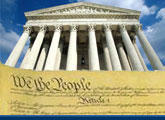
My thinking about what Steve Camp calls "Evangelical Co-Belligerence" had been challenged by reading posts from his websites, CampOnThis and AudienceOne. Camp is certainly impassioned (to make an understatement) on this subject, and believes that not only are evangelical events such as Justice Sunday II misguided and wrong-headed, but its leaders are actually sinning, because according to his arguments such events:
1- use an approach to fighting evils in society not endorsed by Scripture.
2- use the pulpit to make political points, but such points are not being made in the context of worshiping God and instructing the congregation biblically about how it should engage culture.
3- distract the Church from being true to its primary calling of preaching the gospel and bringing its members to full maturity as disciples in Christ.
It was with such thoughts running through my mind that I sat down to watch the broadcast of Justice Sunday II on TBN this past Sunday evening.
The event was held at a church (Two Rivers Baptist Church in Nashville, TN), and on a Sunday, so it does seem that at least for this particular night, the church's evening service was being co-opted and turned into a political rally. Apparently, the evening opened up with praise and worship singing, such as would happen at a typical service, but this was not broadcast. In any case, what followed was definitely more a political event than a worship service. Here Camp's criticism seems valid. Is it right to turn the evening service of a church into a political rally?
There were calls to prayer made by various speakers at JS II. Yet it was my impression that the overall challenge was to political (call your Senators, call the White House, write letters, etc.) rather than spiritual action (pray for your leaders, repent, submit to authorities, etc.). Political activity must be part of the solution to America's woes, but is it not far more important that believers should first pray for their leaders as instructed, and be led by example into such prayer by their leaders? For the ultimate solution is not in political activities, which can only change laws, but in the gospel, which alone brings about transformation of the heart. So prayer, together with a clear presentation of the gospel message, must be central to our efforts to engage and change culture. Here again the JSII score card is mixed-- though there was some prayer and calls to prayer, the context emphasized praying for the political stratagems regarding the immediate issues at hand (John Roberts' confirmation to the Supreme Court; a Federal judiciary that should interpret the Constitution, rather than legislate from the bench). But if our nation's primary problems are spiritual in nature, then the Church should first be calling itself and the United States to repentance. As for the gospel, why did one not hear it presented throughout this evening?
Most of the speakers were given only a few minutes each to make their points. I understand the thinking behind this is probably that including as many speakers as possible at this type of event will help convey that this "fight for justice" has a broad range of support, but the limitations on speaker time was conducive to superficiality of commentary. I would have liked to have heard a deeper analysis from these leaders as to the problem, and a clearer presentation of the biblical and theological rationale for their solution. But mostly there was only time for "sound bites", though some of the speakers were more effective and eloquent than others. James Dobson (participating via a taped video) spoke articulately about recent Supreme Court decisions to justify why Christians need to be involved in the political process; Chuck Colson referred to a passage of Scripture from the prophet Amos to effectively make points about Christian involvement in justice, and I thought Senate House Majority Leader Tom Delay gave a good speech that challenged listeners, "it's never enough to stand on the sidelines and watch history pass you by."
Unfortunately some of the other speakers weren't as good. Bill Donahue of the Catholic League came across as angry (though trying to be humorous) as he named names and called one of them a bigot. In contrast to Chuck Colson, who had earlier said that we must suppress the temptation to get angry at the opposition and instead demonstrate Christian love towards all, Donahue's speech seemed petty, an "us vs. them” type of speech.
Zell Miller, the former Senator, is a rousing speaker and had one of the more memorable points of the evening. He asked why is it that government makes sure to post “No Smoking” signs near gas pumps as a warning of physical danger, yet removes the Ten Commandments from public places-- which gives the even more urgent warning about the dangers of a sinful life.
As I was watching here in NY, there was a storm raging outside, affecting my satellite television reception. So I seemed to have missed portions of the broadcast, including the remarks of Phyllis Schafly and Cathy Cleaver Ruse, which I understand from the live bloggers I've read were part of the evening. I also did not see the performance by musician Jett Williams (perhaps all these were edited from the broadcast)?
Analysis
Political rallies such as Justice Sunday II probably have their place in helping to galvanize Christian awareness and action on important current issues, but I am uneasy about the mix of religion with politics, and agree with Camp and other critics about the potential for compromise of the gospel message and its priorities. Also, such an event should be able to take place without substituting for a church's scheduled evening service.
On the other hand, I agree with the need and call for action that evangelical co-belligerents challenge us to. Still the warnings of Camp and others like him seem need to be taken seriously in the light of the scorecard of Justice Sunday II: no presentation of the gospel, no prayer for leaders, little biblical rationale presented for action, a church service turned primarily into a political rally.
An excellent and insightful editorial appears on this topic, by Tom Ascol, appears in The Founders Journal, titled Reformation, Revival and the Religious Right.
I quote from the article below:
<< It is not that the agenda of the religious right is too radical. It is not radical enough. They greatly underestimate the depth of the problem. We cannot "Christianize" culture. The nature of sin guarantees that. Neither are we called to try! Did Jesus or Peter or Paul ever try to organize believers into a voting bloc to "Christianize" any geo-political structure? Culture can and will be positively influenced when its participants are made disciples of Christ.
The moral crisis in our nation will not be solved by getting the right people in the White House, Congress, and on the Supreme Court. Society will not change until people change. And the only way that people can be changed is by the sovereign power of God through the gospel of Jesus Christ. Consequently, proclaiming that gospel in the power of the Spirit is the task to which churches must give themselves. This constitutes the only great commission which we have received from Jesus Christ.
The moral decadence of this generation has a spiritual root. As long as evangelical churches overlook this fact or fail to absorb its implications, they will continue to be seduced by worldly wisdom in their sincere but misguided efforts to "make a difference." Alexis de Tocqueville was prophetic when he warned that if America ever ceased being good, she would cease being great. But why has America lost her goodness? Is it because we have elected the wrong people? Because we outlawed prayer in the public schools? Because we have passed immoral laws? No. These are symptoms, not causes. The reason, very simply stated by Aleksandr Solzhenitsyn, is that "America has forgotten God."
But we must push the question even further. Why has America forgotten God? Whose job is it to speak for God, anyway? Not the schools; not the government; not the culture. That responsibility has been given exclusively to the Church. The sad reality is that the Church--including Bible believing evangelicals--has been derelict in her duty. Our nation is in a mess because our churches are in a mess. >>
I don't think the choice we as Evangelicals face is between engagement and non-engagement. As my brother Daniel has said on this, "we cannot simply run and hide behind our religion". Unlike the church in New Testament times, we live in a democratic republic that allows us opporunity to speak out for the Christian worldview.
I quote here Francis Schaeffer in his speech titled A Christian Manifesto, on true spirituality:
<< ... what I have been talking about, whether you know it or not, is true spirituality. This is true spirituality. Spirituality, after you are a Christian and have accepted Christ as your Savior, means that Christ is the Lord of ALL your life -- not just your religious life, and if you make a dichotomy in these things, you are denying your Lord His proper place. I don't care how many butterflies you have in your stomach, you are poor spiritually. True spirituality means that the Lord Jesus Christ is the Lord of all of life, and except for the things that He has specifically told us in the Bible are sinful and we've set them aside -- all of life is spiritual and all of life is equally spiritual. That includes (as our forefathers did) standing for these things of freedom and standing for these things of human life and all these other matters that are so crucial, if indeed, this living God does exist as we know that He does exist.
We have forgotten our heritage. A lot of the evangelical complex like to talk about the old revivals and they tell us we ought to have another revival. We nee another revival -- you and I need revival. We need another revival in our hearts. But they have forgotten something. Most of the Christians have forgotten and most of the pastors have forgotten something. That is the factor that every single revival that has ever been a real revival, whether it was the great awakening before the American Revolution; whether it was the great revivals of Scandinavia; whether it was Wesley and Whitefield; wherever you have found a great revival, it's always had three parts. First, it has called for the individual to accept Christ as Savior, and thankfully, in all of these that I have named, thousands have been saved. Then, it has called upon the Christians to bow their hearts to God and really let the Holy Spirit have His place in fullness in their life. But there has always been, in every revival, a third element. It has always brought SOCIAL CHANGE!”
The problem with the current Evangelical Co-Belligerence movement is that while it emphasizes actions we can take in response to problems such as judicial activism, abortion, gay marriage, etc., it has not yet helped to usher in that great reformation and revival of heart in the Church that would bring about the deeper social impact that Schaeffer writes about. It seems to "put the cart ahead of the horse", wanting true spiritual results without the prerequisite spiritual transformation. The movement seems to be superficial.
Again quoting Schaeffer, from his book True Spirituality, chapter one:
"The inward area is the first place of loss of true Christian life, of true spirituality, and the outward sinful act is the result. If we can only get hold of this -- that the internal is the basic, the external is always merely the result -- it will be a tremendous starting place."
So we have a responsibility first, to be good Christians: true disciples who love God with all of our hearts, souls, mind and strength; and second, who love our neighbor as ourselves. From the overflow of reformation and revival in the Christian community that comes through repentance in response to the gospel, we will be transformed, and that inner transformation will in turn move us to impact society in a more penetrating way.
Friday, August 12, 2005
Back from Vacation Into a Heat Wave

I'm back and will be posting my regular kind of stuff again shortly. But tonight, I'll just share a bit about where I've been these past few weeks. We've come right back into the middle of a heat wave here in the NYC area, and temperatures are suffocatingly hot --in the 90's-- but add to that the famous NY humidity and bad air quality and you can imagine how miserable it feels here-- except when you're inside, camped out under the AC. Well, I'm thankful we had a chance to breathe fresh mountain air up in the Smoky Mountains for almost a week and a half.
We were at my wife's family reunion, whose primary hosts were the Fees (Gordon and Miriam Jean). They were kind enough to let us stay at their mountain condo--situated between Pigeon Forge and Gatlinburg-- for our entire stay. With a pool right outside the door, a lovely view of the mountains from the terrace, good air-conditioning, fresh air and lots of quiet, it was a very relaxing place getaway. Thank you Gordon and Miriam Jean!
The Fee's son, David, is rather a well-known name in Pigeon Forge. He owns and manages a couple of entertainment businesses -- The Comedy Barn and Black Bear Jamboree, as well as a restaurant called Happy Days Diner. Since he owns them, we were invited to see these shows and eat at the diner afterward free of charge. We also went to a couple of other popular shows, the Dixie Stampede and Dollywood, as guests of the Fees. Thanks again!
Pigeon Forge and Gatlinburg are interesting towns-- together they comprise kind of a smaller, family-oriented Las Vegas, with entertainment featuring "hillbilly" humor, bluegrass, gospel, racing carts, and amusement parks, and with tons of places to eat. Gatlinburg seems to have more shops and art galleries, while Pigeon Forge was marked by its central "strip" featuring the various entertainments mentioned above.
Traffic on the strip moves along at a stately 35 miles an hour-- it seems the pace of life is a bit slower than that of New York. So it was nice to get away, though I did get a bit tired and stressed at times from all the driving.
Anyway, it's good to be back home. If you visited my blog while I was away, I hope you found something that blessed, or at least entertained you.
Thursday, July 28, 2005
Going On Vacation
We'll be on vacation for the next two weeks-- though I will try to post if I can get the opportunity. Take care! Alex
Wednesday, July 27, 2005
Christian Manifestos and Evangelical Co-Belligerence
I recently posted links to two articles, one, a 1982 address titled A Christian Manifesto by the late Presbyterian minister and author Francis Schaeffer, based on his well-known book of the same name, and the other, a more recent manifesto by Christian philosophy professor/author Doug Groothuis, titled Christian Apologetics Manifesto: 17 Theses, which outlines how apologetics ought to be pursued by Christians. I posted these because together they are a galvanizing call to action to the Christian community. Both authors say that Scripture compels Christians to act; Schaeffer also argues that bringing a historical perspective to the times we are living in is critical to understanding what we face and how to respond accordingly. I think that in calling Christians to action both rightly follow the mandate of Jesus Christ that we are to function as "salt and light" to the world (Matthew 5: 13-16). Nevertheless their manifestos need to be evaluated carefully in the light of Scripture, to see if all their conclusions and recommendations are indeed biblically accurate.
Then last week, I came across Steve Camp's excellent blog CampOnThis, and also his website AudienceOne, and was challenged by many of his articles to more deeply consider my own position and thinking on a central question brought out by these manifestos: what is the biblical mandate given to Christians for engaging the world and culture? Steve Camp's websites post a number of articles that warn of the The Dangers of Evangelical Cobelligerence.
What is evangelical co-belligerence? Co-belligerence is a term that describes when individuals or groups band together to wage war against a common enemy. Each member of such an alliance is a co-belligerent. Co-belligerents may not share the same beliefs and may not ordinarily have a close and "friendly" association with each other, but they band together on the basis of shared points of agreement and their goal to defeat a common enemy. Thus, evangelical co-belligerence describes when evangelical Christians get together with people of various denominations (or even unbelievers), to pool resources, intelligence and energies as they fight for the betterment of society on a number of different causes (abortion, prayer in schools, defending traditional marriage, who gets on the Supreme Court, etc).
The articles by Mr. Camp have challenged me to re-examine Scripture to determine Christian strategy for reaching our world. I believe that Schaeffer was right when he said that evangelical silence during the latter half of the twentieth century was culpable for allowing a humanistic system of thought to infiltrate and become dominate in our educational system, the media, the law and other aspects of society. Thus Schaeffer's manifesto calls for Christians to make their voice known, and to fight for the Christian worldview, through "every appropriate legal and political governmental means". The article by Groothuis states "the fundamental issue for apologetics is not how many apologists one has read, or what apologetic method one embraces (although that must be worked out). Rather, the fundamental issue is whether or not one has a passion for God’s truth—reasonably pursued and courageously communicated—and a passion for the lost because of the love of God resident in one’s life." His emphasis on being motivated by the passion for the lost that derives from God's love expressed in and through us is excellent. But is it true that the apologetic method we embrace is not also fundamentally important? It is clear that Jesus does want us to affect our society for the good, but the question of what are appropriate means for doing so has been frequently debated.
Well-known Christian evangelicals such as Al Mohler (see his article in Touchstone), Chuck Colson, James Dobson and others have followed the co-belligerance model, forging alliances with those who have the same attitude towards problems like abortion or protecting marriage, and using a campaign that seems dominated by political strategies to attack these problems.
Camp makes a powerful and, I think, biblically sound plea, that the focus of Christian activism must not become politics, legislation, and forging alliances based on the cause at hand. Camp points out how Paul's strategy to reach the extremely morally corrupt city of Corinth did not involve using political means, but focused rather upon preaching Christ forcefully and boldly, and making sure that the church was becoming mature as it repented from worldliness.
He says, "If in that sinful city, which is seldom if ever rivaled in our day, the Apostle would not stoop to co-belligerent moral political tactics, then by what justification do the Evangelical Co-Belligerents of today function and strive? Paul never 'focused on political moral intervention'; he focused on the Lord, he focused on the faith, he focused on the gospel, he focused on the church, he focused on the cross, he focused on repentance; he focused on the Word, and he focused on the ministry ".
I have talked elsewhere of how I think Billy Graham's compromises with doctrinal purity came about through his alliance with Roman Catholic and liberal churches in his ministry, and has seemed to lead him down a path of doctrinal murkiness even in his own thinking (as evidenced by recent interviews). The co-belligerence principle seemed to have been applied in his ministry. Graham's goal to reach as many as possible with the gospel, led him to take the pragmatic approach that he could get more workers on his team by working with churches that-- in the early stages of his ministry-- he seems to have recognized as doctrinally deficient. Nevertheless it seems that for him, the "ends justified the means", and it was more important to build a consensus of like-minded believers working to achieve the same goal (evangelism and getting people back to church) than to contend for sound doctrine.
But God does not work that way. When we work for Him, we are to use His means and methods, because these must be suited to His purposes, if His goal is to be the one we accomplish (1 Peter 4: 11, 1 Cor 3: 11-13). I have not yet worked out all of these issues in my own mind, but I believe that Mr. Camp is on the right track. I am thankful for his humbly stated reminder that we ought to function as "Bereans" as we examine these issues: "When it comes to matters of faith--matters of eternity, ... believers in the Lord Jesus Christ should.. examine, investigate, research, and study the claims of anyone who sets themselves up as a teacher of God's Word by word or song (including yours truly too) when they say they speak for God and represent His truth and gospel".
And we would do well to remember the words of the Apostle Paul:
"For Jews demand signs and Greeks seek wisdom, but we preach Christ crucified, a stumbling block to Jews and folly to Gentiles, but to those who are called, both Jews and Greeks, Christ the power of God and the wisdom of God (1 Cor 1: 22-24)",
"And I, when I came to you, brothers, did not come proclaiming to you the testimony of God with lofty speech or wisdom. For I decided to know nothing among you except Jesus Christ and him crucified. And I was with you in weakness and in fear and much trembling, and my speech and my message were not in plausible words of wisdom, but in demonstration of the Spirit and of power, that your faith might not rest in the wisdom of men but in the power of God (1 Cor 2: 1-5)".
And to remember, most of all, the words of our Lord:
And Jesus came and said to them, "All authority in heaven and on earth has been given to me. Go therefore and make disciples of all nations, baptizing them in the name of the Father and of the Son and of the Holy Spirit, teaching them to observe all that I have commanded you. And behold, I am with you always, to the end of the age." Matthew 28: 18-20
Since our primary commission is make disciples, baptize in the name of the Father and of the Son and of the Holy Spirit, and teach others to observe everything that Jesus has commanded, Mr. Camp is on the right track when he says that our focus in trying to affect the world should not be shifted over to political strategems. Lives truly changed by the power of God working in the lives of fully submitted believers is the best and most powerful testimony the world can experience. Such believers truly can turn the world upside down (Acts 17:6), just as the early church did.
Then last week, I came across Steve Camp's excellent blog CampOnThis, and also his website AudienceOne, and was challenged by many of his articles to more deeply consider my own position and thinking on a central question brought out by these manifestos: what is the biblical mandate given to Christians for engaging the world and culture? Steve Camp's websites post a number of articles that warn of the The Dangers of Evangelical Cobelligerence.
What is evangelical co-belligerence? Co-belligerence is a term that describes when individuals or groups band together to wage war against a common enemy. Each member of such an alliance is a co-belligerent. Co-belligerents may not share the same beliefs and may not ordinarily have a close and "friendly" association with each other, but they band together on the basis of shared points of agreement and their goal to defeat a common enemy. Thus, evangelical co-belligerence describes when evangelical Christians get together with people of various denominations (or even unbelievers), to pool resources, intelligence and energies as they fight for the betterment of society on a number of different causes (abortion, prayer in schools, defending traditional marriage, who gets on the Supreme Court, etc).
The articles by Mr. Camp have challenged me to re-examine Scripture to determine Christian strategy for reaching our world. I believe that Schaeffer was right when he said that evangelical silence during the latter half of the twentieth century was culpable for allowing a humanistic system of thought to infiltrate and become dominate in our educational system, the media, the law and other aspects of society. Thus Schaeffer's manifesto calls for Christians to make their voice known, and to fight for the Christian worldview, through "every appropriate legal and political governmental means". The article by Groothuis states "the fundamental issue for apologetics is not how many apologists one has read, or what apologetic method one embraces (although that must be worked out). Rather, the fundamental issue is whether or not one has a passion for God’s truth—reasonably pursued and courageously communicated—and a passion for the lost because of the love of God resident in one’s life." His emphasis on being motivated by the passion for the lost that derives from God's love expressed in and through us is excellent. But is it true that the apologetic method we embrace is not also fundamentally important? It is clear that Jesus does want us to affect our society for the good, but the question of what are appropriate means for doing so has been frequently debated.
Well-known Christian evangelicals such as Al Mohler (see his article in Touchstone), Chuck Colson, James Dobson and others have followed the co-belligerance model, forging alliances with those who have the same attitude towards problems like abortion or protecting marriage, and using a campaign that seems dominated by political strategies to attack these problems.
Camp makes a powerful and, I think, biblically sound plea, that the focus of Christian activism must not become politics, legislation, and forging alliances based on the cause at hand. Camp points out how Paul's strategy to reach the extremely morally corrupt city of Corinth did not involve using political means, but focused rather upon preaching Christ forcefully and boldly, and making sure that the church was becoming mature as it repented from worldliness.
He says, "If in that sinful city, which is seldom if ever rivaled in our day, the Apostle would not stoop to co-belligerent moral political tactics, then by what justification do the Evangelical Co-Belligerents of today function and strive? Paul never 'focused on political moral intervention'; he focused on the Lord, he focused on the faith, he focused on the gospel, he focused on the church, he focused on the cross, he focused on repentance; he focused on the Word, and he focused on the ministry ".
I have talked elsewhere of how I think Billy Graham's compromises with doctrinal purity came about through his alliance with Roman Catholic and liberal churches in his ministry, and has seemed to lead him down a path of doctrinal murkiness even in his own thinking (as evidenced by recent interviews). The co-belligerence principle seemed to have been applied in his ministry. Graham's goal to reach as many as possible with the gospel, led him to take the pragmatic approach that he could get more workers on his team by working with churches that-- in the early stages of his ministry-- he seems to have recognized as doctrinally deficient. Nevertheless it seems that for him, the "ends justified the means", and it was more important to build a consensus of like-minded believers working to achieve the same goal (evangelism and getting people back to church) than to contend for sound doctrine.
But God does not work that way. When we work for Him, we are to use His means and methods, because these must be suited to His purposes, if His goal is to be the one we accomplish (1 Peter 4: 11, 1 Cor 3: 11-13). I have not yet worked out all of these issues in my own mind, but I believe that Mr. Camp is on the right track. I am thankful for his humbly stated reminder that we ought to function as "Bereans" as we examine these issues: "When it comes to matters of faith--matters of eternity, ... believers in the Lord Jesus Christ should.. examine, investigate, research, and study the claims of anyone who sets themselves up as a teacher of God's Word by word or song (including yours truly too) when they say they speak for God and represent His truth and gospel".
And we would do well to remember the words of the Apostle Paul:
"For Jews demand signs and Greeks seek wisdom, but we preach Christ crucified, a stumbling block to Jews and folly to Gentiles, but to those who are called, both Jews and Greeks, Christ the power of God and the wisdom of God (1 Cor 1: 22-24)",
"And I, when I came to you, brothers, did not come proclaiming to you the testimony of God with lofty speech or wisdom. For I decided to know nothing among you except Jesus Christ and him crucified. And I was with you in weakness and in fear and much trembling, and my speech and my message were not in plausible words of wisdom, but in demonstration of the Spirit and of power, that your faith might not rest in the wisdom of men but in the power of God (1 Cor 2: 1-5)".
And to remember, most of all, the words of our Lord:
And Jesus came and said to them, "All authority in heaven and on earth has been given to me. Go therefore and make disciples of all nations, baptizing them in the name of the Father and of the Son and of the Holy Spirit, teaching them to observe all that I have commanded you. And behold, I am with you always, to the end of the age." Matthew 28: 18-20
Since our primary commission is make disciples, baptize in the name of the Father and of the Son and of the Holy Spirit, and teach others to observe everything that Jesus has commanded, Mr. Camp is on the right track when he says that our focus in trying to affect the world should not be shifted over to political strategems. Lives truly changed by the power of God working in the lives of fully submitted believers is the best and most powerful testimony the world can experience. Such believers truly can turn the world upside down (Acts 17:6), just as the early church did.
Saturday, July 23, 2005
Christian Apologetics Manifesto-17 Theses by Doug Groothuis
New blogger Doug Groothuis, a philosophy professor and author, has posted a fine article (click title link above), on his site Culture Watch: Thoughts of a Constructive Curmudgeon. I believe his thoughts/directives concerning how we should conduct ourselves as Christian apologists is a good complement to the Francis Schaeffer's 1982 address The Christian Manifesto that I recently posted.
I am pleased to continue to find all of these great resources for Christians which can help and challenge us as we mature in the faith, as well as become better ambassadors.
What I am challenged by personally is the thought that we must be intellectually prepared to provide a defense of the faith as reasonable, and at the same time, we should be spurred on by our passion for the lost.
I have to admit that the passion has been lacking sometimes, perhaps because I am not following through on actually sharing with "live" people, but getting too bogged down with working out all the arguments. Peter and the other disciples were unschooled men, yet the Spirit of wisdom was working inside them, enabling them to confound even educated religious leaders. Praise God!
On the other hand, I do view my blog as a tool of apologetics and I have been working quite hard on it. And since I enjoy writing, it is a good and natural way for me to make a contribution to the marketplace of ideas. Yet I ought to do both-- take it to the streets-- and -- blog it!
P.S. Check out the Apologetics and Culture section-- I have added a number of new links to excellent apologetic resources.
I am pleased to continue to find all of these great resources for Christians which can help and challenge us as we mature in the faith, as well as become better ambassadors.
What I am challenged by personally is the thought that we must be intellectually prepared to provide a defense of the faith as reasonable, and at the same time, we should be spurred on by our passion for the lost.
I have to admit that the passion has been lacking sometimes, perhaps because I am not following through on actually sharing with "live" people, but getting too bogged down with working out all the arguments. Peter and the other disciples were unschooled men, yet the Spirit of wisdom was working inside them, enabling them to confound even educated religious leaders. Praise God!
On the other hand, I do view my blog as a tool of apologetics and I have been working quite hard on it. And since I enjoy writing, it is a good and natural way for me to make a contribution to the marketplace of ideas. Yet I ought to do both-- take it to the streets-- and -- blog it!
P.S. Check out the Apologetics and Culture section-- I have added a number of new links to excellent apologetic resources.
Thursday, July 21, 2005
A Christian Manifesto by Dr. Francis A. Schaeffer
Click this link to read a fantastic speech by the late Dr. Francis A. Schaeffer, a wonderful Reformed theologian and scholar. The speech was given in 1982 at the Coral Ridge Presbyterian Church, Fort Lauderdale, Florida. It is based on one of his books, which bears the same title.
It is a prophetic speech: looking at the current state of our country and of the Supreme Court, one might think that it was presented just last week, given how timely and relevant to today are its themes.
In light of the battle we may face in the immediate future to confirm President Bush's nominee to the Supreme Court, this speech reminds us of how critically important the stakes are, and helps us to reflect on the fundamental principles involved in the Christian's challenge to honor God in all spheres of life.
It is a prophetic speech: looking at the current state of our country and of the Supreme Court, one might think that it was presented just last week, given how timely and relevant to today are its themes.
In light of the battle we may face in the immediate future to confirm President Bush's nominee to the Supreme Court, this speech reminds us of how critically important the stakes are, and helps us to reflect on the fundamental principles involved in the Christian's challenge to honor God in all spheres of life.
The Battle for the Supreme Court: Why It Matters
July 21, 2005
President Bush yesterday evening nominated conservative Judge John Roberts Jr. to the Supreme Court. Although I don't yet know much about the man, from the reports I've read thus far, he appears to be the kind of nominee that Bush has previously promised: conservative, and a strict interpreter of the law according to the Constitution (i.e, a constructionist). Christians should pray that he indeed is such a man, and if he is, for his speedy confirmation.
Why is the battle over who becomes the next Supreme Court justice so critical? The Supreme Court has gained such power and authority in the nation's affairs that its decisions impact the lives of all Americans far into the future, just as its past decisions are still affecting us up to the present moment.
Coincidentally, the Canadian Supreme Court yesterday signed into law legislation legalizing gay marriage, making Canada the fourth country in the world to make gay marriage legal (Netherlands, Belgium and Spain are the others). Such a decision could happen here too, especially if the balance of the US Supreme Court were to shift leftward. Theoretically and ideally, the decisions of the Supreme Court are not supposed to legislate new laws into being, but rather to interpret the law according to the Constitution, and according to legal precedent. But the current Supreme Court, despite the fact that many of its appointments came from the conservative Reagan and Bush administrations (O'Connor, Kennedy and Souter), has been unpredictable in its rulings. In many cases, it has demonstrated a willingness to set new precedents and to create new laws, inventing so-called "rights" not found in the Constitution.
It is for this reason that conservative Christians have called on President Bush to nominate to the Highest Court strict constructionists, who hopefully will join the more conservative justices (Scalia, Renquist and Thomas) in making rulings that reflect this approach. With the selection of Judge John Roberts Jr., it seems that President Bush has made good on earlier promises to deliver such a nominee. "Republicans believe Roberts is more conservative than O'Connor, the first female justice. They would prefer to have him voting on close cases than O'Connor, who has been the swing vote in several 5-4 decisions"*.
And of course Christians desire that not only will such a Court's decisions be less activist, but also more a reflection of Christian values.
*(this quote taken from a July 21, 2005 Washington Post story by Peter Baker and Charles Babington).
The Deepening Consitutional Crisis (collection of articles related to the Supreme Court)
President Bush yesterday evening nominated conservative Judge John Roberts Jr. to the Supreme Court. Although I don't yet know much about the man, from the reports I've read thus far, he appears to be the kind of nominee that Bush has previously promised: conservative, and a strict interpreter of the law according to the Constitution (i.e, a constructionist). Christians should pray that he indeed is such a man, and if he is, for his speedy confirmation.
Why is the battle over who becomes the next Supreme Court justice so critical? The Supreme Court has gained such power and authority in the nation's affairs that its decisions impact the lives of all Americans far into the future, just as its past decisions are still affecting us up to the present moment.
Coincidentally, the Canadian Supreme Court yesterday signed into law legislation legalizing gay marriage, making Canada the fourth country in the world to make gay marriage legal (Netherlands, Belgium and Spain are the others). Such a decision could happen here too, especially if the balance of the US Supreme Court were to shift leftward. Theoretically and ideally, the decisions of the Supreme Court are not supposed to legislate new laws into being, but rather to interpret the law according to the Constitution, and according to legal precedent. But the current Supreme Court, despite the fact that many of its appointments came from the conservative Reagan and Bush administrations (O'Connor, Kennedy and Souter), has been unpredictable in its rulings. In many cases, it has demonstrated a willingness to set new precedents and to create new laws, inventing so-called "rights" not found in the Constitution.
It is for this reason that conservative Christians have called on President Bush to nominate to the Highest Court strict constructionists, who hopefully will join the more conservative justices (Scalia, Renquist and Thomas) in making rulings that reflect this approach. With the selection of Judge John Roberts Jr., it seems that President Bush has made good on earlier promises to deliver such a nominee. "Republicans believe Roberts is more conservative than O'Connor, the first female justice. They would prefer to have him voting on close cases than O'Connor, who has been the swing vote in several 5-4 decisions"*.
And of course Christians desire that not only will such a Court's decisions be less activist, but also more a reflection of Christian values.
*(this quote taken from a July 21, 2005 Washington Post story by Peter Baker and Charles Babington).
The Deepening Consitutional Crisis (collection of articles related to the Supreme Court)
Utilizing The Power of the Internet
Last month, I wrote about how you can Grow Your Christian Life Via the Web. I probably used the wrong term in my title, "Web", because according the official definitions, the Web (short for World Wide Web- www) refers to a service that operates over the Internet. So really the Web is a subset of the Internet, which is the "publicly accessible worldwide system of interconnected computer networks" that provide all the great free resources that I talked about in that article. The "Internet" would have been the more accurate term to use in my title, although many people, use the terms Web and Internet synonymously.
Whether you call it "Web" or "Internet", the vast resources we are privileged enough to tap into (if fortunate enough to have access to a computer with Internet access) is truly staggering. It's amazing to realize too, that the Internet is such a young phenomenon, having only become what it now is, a free public global network, during the 1990's!
As mentioned in the previous article, I have hoped to make this blog into a valuable resource for visitors by highlighting and organizing links through which you can utilize some of those vast resources. I have continued to add link items. For example, I have now created two new sections. "Public Policy Organizations" provides links to several organizations at the forefront of the task of shaping public policy, in terms of Christian values and ideals. "News from a Christian Perspective" provides links to organizations that report on the news through a Christian lens, and which highlight issues and areas that secular news organizations may neglect.
With President Bush's announcement last night of John Roberts as his nominee for the Supreme Court position that Sandra Day O'Connor vacates through retirement, it is so important that believers continue praying and staying informed about the current issues shaping the future of America. The links I have provided are some of the sites I have found helpful in this important task. Again, I welcome your suggestions of other good resources.
Of course, bloggers have also revealed themselves to be an influential force, because the rapid dissemination of information made possible by the Internet makes it possible for bloggers to quickly respond, and in effect, can become a collective voice. Such blogging can help to keep news organizations accountable. Additionally those in the Christian blogosphere have a wonderful opportunity to influence cultures with Christian truth, by engaging the marketplace of ideas. Let us utilize this power for good, remembering at all times to pray.
Whether you call it "Web" or "Internet", the vast resources we are privileged enough to tap into (if fortunate enough to have access to a computer with Internet access) is truly staggering. It's amazing to realize too, that the Internet is such a young phenomenon, having only become what it now is, a free public global network, during the 1990's!
As mentioned in the previous article, I have hoped to make this blog into a valuable resource for visitors by highlighting and organizing links through which you can utilize some of those vast resources. I have continued to add link items. For example, I have now created two new sections. "Public Policy Organizations" provides links to several organizations at the forefront of the task of shaping public policy, in terms of Christian values and ideals. "News from a Christian Perspective" provides links to organizations that report on the news through a Christian lens, and which highlight issues and areas that secular news organizations may neglect.
With President Bush's announcement last night of John Roberts as his nominee for the Supreme Court position that Sandra Day O'Connor vacates through retirement, it is so important that believers continue praying and staying informed about the current issues shaping the future of America. The links I have provided are some of the sites I have found helpful in this important task. Again, I welcome your suggestions of other good resources.
Of course, bloggers have also revealed themselves to be an influential force, because the rapid dissemination of information made possible by the Internet makes it possible for bloggers to quickly respond, and in effect, can become a collective voice. Such blogging can help to keep news organizations accountable. Additionally those in the Christian blogosphere have a wonderful opportunity to influence cultures with Christian truth, by engaging the marketplace of ideas. Let us utilize this power for good, remembering at all times to pray.
Tuesday, July 19, 2005
New Blogger In The Big Apple
There's a new blogger in town and he's a City Pastor With Attitude. He's also my brother Daniel Jordan, an actor-turned-pastor and a pretty cool dude. Terrific family too...
We've been having "blog talks" for a while and I think I was an influence on him to start his own blog. Since he'd already been doing various series of teachings for his church, Living Hope NY (based in Manhattan), his blog launches with quite a backlog of material.
Daniel is a dynamic preacher whose excitement is infectious. During his preaching he's been known to jump up and down and even sweat, but his sermons don't appeal only to the emotions-- they're well-thought out, simply spoken and very applicational. His desire is to make an impact on NYC, and one of the means he uses to this end, in addtion to planting churches, is a "Prayer Table" ministry. That is, he sets up a table in some busy section of the city, puts up a sign saying "Free Prayer", and prays for people who stop by, sharing the gospel with them as well. Others often work with him in this venture (I've done it a few times myself); thus the prayer table ministry has become a training ground for Christians who want to get a taste of street ministry in an urban environment.
People are grateful to have someone who cares enough to pray with them about their concerns, so very often they are open to hearing about Jesus as well. Some folks that Daniel has prayed for have ended up at his church. Daniel knows the value of street ministry that opens the door for God to change people's lives-- he himself came to the Lord after a woman witnessed to him once day on the street...
Some of the best Christian blogs are being written by blogging pastors--so I urge you to visit his site as he develops his blog! Today for example he's posted an excellent article on secular music which stresses that liberty must co-exist with discernment in a believer's life, enabling us to make wise, God-honoring choices about music and other arts yet without imposing our judgments about these things upon others. It's a post I certainly relate to, being a songwriter who has been inspired more by secular artists than Christian.
We've been having "blog talks" for a while and I think I was an influence on him to start his own blog. Since he'd already been doing various series of teachings for his church, Living Hope NY (based in Manhattan), his blog launches with quite a backlog of material.
Daniel is a dynamic preacher whose excitement is infectious. During his preaching he's been known to jump up and down and even sweat, but his sermons don't appeal only to the emotions-- they're well-thought out, simply spoken and very applicational. His desire is to make an impact on NYC, and one of the means he uses to this end, in addtion to planting churches, is a "Prayer Table" ministry. That is, he sets up a table in some busy section of the city, puts up a sign saying "Free Prayer", and prays for people who stop by, sharing the gospel with them as well. Others often work with him in this venture (I've done it a few times myself); thus the prayer table ministry has become a training ground for Christians who want to get a taste of street ministry in an urban environment.
People are grateful to have someone who cares enough to pray with them about their concerns, so very often they are open to hearing about Jesus as well. Some folks that Daniel has prayed for have ended up at his church. Daniel knows the value of street ministry that opens the door for God to change people's lives-- he himself came to the Lord after a woman witnessed to him once day on the street...
Some of the best Christian blogs are being written by blogging pastors--so I urge you to visit his site as he develops his blog! Today for example he's posted an excellent article on secular music which stresses that liberty must co-exist with discernment in a believer's life, enabling us to make wise, God-honoring choices about music and other arts yet without imposing our judgments about these things upon others. It's a post I certainly relate to, being a songwriter who has been inspired more by secular artists than Christian.
Subscribe to:
Posts (Atom)